Tuesday, October 26, 2004

Italian occupation 101

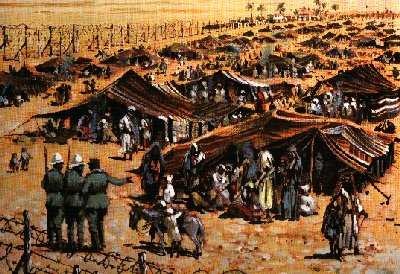
Today, 26 of October coincides with the anniversary of what the Libyans call the Black Day’, on this day in 1911 the Italian fascist invaders shipped thousands of Libyan men, women and children to some small and remote Italian islands. No one knows anything about their fate! Up to this very day, the Italian authorities have refused to furnish the full list of these Libyan victims to the Government and People of Libya. Libya holds an annual Day of Mourning.

So I think it is time for a little history lesson and a reply to another of your questions:

17. How would you describe Libya's relationship with Italy? From my point-of-view, it looks like it's quite sound. Can I assume that Italy's colonial past was less abhorrent than that of many other colonizing countries?

All occupation is abhorrent and the Italian one was not an exception: almost one million Libyans died during the Italian occupation from 1911 to 1944!
Like most of the peoples of the Third World, the Libyans have suffered, and are still suffering, great injustices from the Western powers. The history of the Libyan people is a history of blood, tears and broken bones. The people of Libya have been terrorised and victimised for many decades by the various European powers. With the tacit approval of the British and French governments, Italy declared war on Libya on September 12, 1911, under the excuse that the Ottoman Turks — who were then ruling Libya were subject to insults and maltreatment for which they were in danger! On September 17, 1911, the Italians invaded Tripoli and Benghazi. The Italians expected that their invasion of Libya would be easily accomplished. But, to their horror, their aggression was courageously and strongly resisted by the Libyan people. For 20 terrible years Arab Libyan resistance fighters and guerrillas fought against Italian fascists with sweat and blood. The courage of the Libyan martyrs was epitomised by a very old man Sheikh Omar al Mukhtar. A true hero.
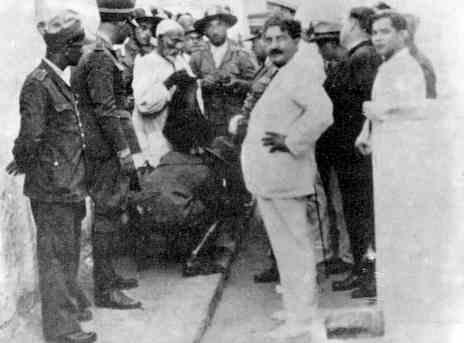

Omar Mukhtar upon his capture in September 1931.
Highlander


Omar Mukhtar, the 'fierce and frightening warrior on his way to the gallows'. notice the chains and the escort- what does it remind you of?
Highlander


The Italian aggression and terrorism against Libya was extremely brutal. Thousands of innocent men, women and children were killed. Their homes were burnt down, their crops destroyed, their wells filled with cement, and copies of their Koran stepped upon. Many women were raped. Thousands of other Libyans were detained in concentration camps in the hot desert. Their properties were confiscated. Others perished under the most repressive conditions. Furthermore, the Italians, had laid about 170,000 landmines all over the country. These landmines have killed and are continuing to kill and maim many Libyans. Italy has refused to furnish maps showing where these landmines were laid. When Benito Mussolini, the Italian fascist dictator, was carrying on his terrorism against the Libyan people, he was highly praised by British, French and American politicians, business leaders and the press.

*For instance, on a visit to Mussolini in 1927, Winston Churchill told journalists that Italian fascism “has rendered a service to the whole world.”
'Inarguably, throughout the whole of the 1920s, Mussolini was an enormously popular man in Italy and abroad, with all except perhaps the most inveterate leftists. An American writer puts it as follows:
Postwar [First World War] Italy ... was a sewer of corruption and degeneracy. In this quagmire Fascism appeared like a gust of fresh air, a tempest-like purgation of all that was defiled, leveled, fetid. Based on the invigorating instincts of nationalist idealism, Fascism "was the opposite of wild ideas, of lawlessness, of injustice, of cowardice, of treason, of crime, of class warfare, of special privilege; and it represented square-dealing, patriotism and common sense." As for Mussolini, "there has never been a word uttered against his absolute sincerity and honesty. Whatever the cause on which he embarked, he proved to be a natural-born leader and a gluttonous worker." Under Mussolini's dynamic leadership, the brave Blackshirts made short shrift of the radicals, restored the rights of property, and purged the country of self-seeking politicians who thrive on corruption endemic to mass democracy." [30]If the Italian Duce was so popular in the 1920s that he received the accolades of the Saturday Evening Post [31] and the American Legion [32], and the highest praises of British and American establishment figures such as Winston Churchill [33] and Ambassador Richard Washburn Child, [34]


[30] John P. Diggins, Mussolini and Fascism: The View from America (Princeton, NJ: Princeton University Press, 1972), p. 17. Diggins' quotations in the cited paragraph come from the writings of an American Mussolini enthusiast of the 1920s, Kenneth L. Roberts.
[31] Ibid., p. 27.
[32] Ibid., p. 206. Mussolini was officially invited to attend the San Francisco Legion Convention of 1923 (he declined) and some years later was made an honorary member of the American Legion by a delegation of Legionnaires visiting Rome. The Duce received the delegation in his palace and was awarded a membership badge by the delighted American visitors.
[33] In an interview published in the London Times, January 21, 1927, immediately after a visit by Churchill to Mussolini, the future British Prime Minister said: "If I had been an Italian I am sure that I should have been wholeheartedly with you [Mussolini] from start to finish in your triumphant struggle against the bestial appetites and passions of Leninism." See Luigi Villari, Italian Foreign Policy Under Mussolini (New York: The Devin-Adair Company, 1956), p. 43.
[34] The United States Ambassador to Italy in the '20s, Child dubbed Mussolini "the Spartan genius," ghostwrote an "autobiography" of Mussolini for publication in America, and perpetually extolled the Italian leader in the most extravagant terms. Diggins, p. 27.

*In 1933 American President Franklin Roosevelt himself termed Mussolini “that admirable Italian gentleman.”


Libya’s relationship with Italy has been and is very cordial though. Libyans love to go to Italy. But the Italians have been smarter ex-colonialists than other countries and that is why they are less resented nowadays. In the 80s and 90s, Libyan leader Muammar Gaddafi repeatedly demanded reparations from Italy for the colonial period:

“ Italy perpetrated historical crimes against the peaceful Libyan Arab people, the people who did not know Italy, and who did not harbour any ill will against Italy. It was Italy that surprised the Libyans with its fleets and cannons, and attacked the Libyans in their homes, set up the gallows, killed thousands of martyrs, and acted unjustly and most aggressively.

“An invasion without justification, and sacrifices without reason... It is impossible that we forget 35 years of colonization, and it is impossible that we forget them, and we will never forget 700,000 martyrs... and those who were executed because they defended Libya.”

Italy replied that it had settled all obligations in a payment worth $6.7m in 1956. And in 1998, the Italian and Libyan governments signed an agreement ending the conflict [the Italy-Libya statement]. Italy apologised for deporting unknown thousands of Libyans to barren islands in southern Italy, where many died from disease, famine and bad weather.

It is worth mentioning that Italy imports oil and natural gas from Libya.

This was the list of Libyan demands:

a-Italy should acknowledge its historical crimes against the people of Libya
b-Furnish all details about the thousands of Libyans forcibly exiled onto some Italian islands
c-Furnish maps showing where thousands of Italian landmines were laid in Libya
d-Pay full compensation to the families of all victims of Italian terrorism
e-Return all historical treasures and artifacts stolen from Libya

Public hangings of Libyan resistance fighters.


"In September, 1930, security forces in the Birka district of Benghazi discovered that a citizen named Muhammed El-Haddad, a prominent Benghazi citizen and merchant, was cooperating with the rebels... Through him, supplies and weapons were reaching them. He offered the rebels hospitality and all the supplies they needed. On the day and time appointed, a special tribunal was convened and sentenced the father and son to death by hanging in the middle of his estates and right in front of the masses. These latter were made to attend the execution by the Italian authorities.." - Italian General Graziani
Highlander
Aguila concentration camps in Libya


“We proclaim to the people of Libya that, owing to the acts committed by the white Abadila tribe, namely secretly helping five fighting men to reach the rebel areas after having furnished them with arms and supplies, and in order to punish this tribe of 80 tents, all its old people, adults and children are to be removed to the Uqayla [concentration] camp, and their property to be confiscated, so that the tribe can serve as an example to anyone who might contemplate a similar act, as his punishment will be more severe.” — Decree of the Special Italian Tribunal
Highlander

Wednesday, October 20, 2004


Tripoli Coast
Highlander

If you enjoyed this photo of Tripoli ...there are more here please have a look I took them recently .

Monday, October 18, 2004

Food for thought

I'm going to intercept this blog from time to time with what I think are relevant/interesting quotes from authors I have read.
So here is the second one folks.

  • 'We cannot conclude from the good intentions of a statesman that his foreign policies will be either morally praiseworthy or politically successful'

  • 'How often have statesmen been motivated by the desire to improve the world, and ended making it worse? And how often have they sought one goal and ended by achieving something they neither expected nor desired?'

  • 'The demonological approach to foreign policy strenghtens another pathological tendency, which is the refusal to acknowledge and cope effectively with threatening reality'

Hans J. Morgenthau- Kenneth W. Thompson

Wednesday, October 13, 2004

My two pence about the US presidential elections and its effect on the ME (warning long post so for the faint of heart abstain from reading)

I must give credit to my friend W. in California who explained to me all these intricacies and what I have quoted from his emails is in ‘ ----- ‘ form.

Sometime in August I started following the run up to the presidential elections.

Things did not look good for Mr. Bush then, and Mr. Kerry seemed to be ahead. So I thought that Mr. Bush’s only hope would be another major act against the USA ‘ or that cultural issues such as gay marriage etc.. work in his favour.’

Then I noticed that Kerry was courting the American/Arab Islamic vote and ‘he approached every constituency but unfortunately had nothing new or different to say especially regarding the Israeli-Palestinian conflict’. I mean he cannot alienate Jewish voters either now can he? don’t know what new he could do or say about that matter. ‘So he will end up just sending a new USA envoy to the region to deal with that issue and that will amount to nothing. I say there isn’t much more he could do even if he wanted because what is the basis? There doesn’t seem to be any desire in Israel to move on a settlement-the wall seems very very popular with the Israeli public - and removing the wall would seem the most basic demand of the Palestinians at the moment – so I just don’t see where talks would start up again—Kerry or no Kerry. I mean Kerry might be more concerned than Bush about getting talks moving (Bush is almost totally unconcerned and never was very interested in getting talks going) but I don’t see where he would have anything to offer in talks except another envoy and what good does that do?’ In addition it isn’t even clear how much authority Mr. Arafat has now among his own people. Certainly in Gaza it looks like his authority is almost non existent.


‘On Iraq, again, hard to see where Kerry would do anything different. He isn’t really for pulling out. Of the presidential candidates only the third party candidate Ralph Nader (a Lebanese-American) an old radical lawyer from the 1960s is arguing for immediate withdrawal.’ Kerry and Bush pretty much agree [stay in Iraq for about another 5 years]. Kerry says he would bring in allies to help but doesn’t say how or who. All he can say is that the Europeans like him more.


Interesting however that Z. Brezsinski, Jimmy Carter’s national security advisor back in the 1970s and the architect of the American support to Afghan resistance to the USSR in 1979 recently came out with a report strongly advising USA to normalize relations with Iran. ‘He said, that if USA is waiting for a radical liberal government to come to power before normalizing relations—then forget it: that isn’t going to happen and he has a point. So his point is normalize or don’t but don’t hinge it on a government you like coming to power in Tehran. He also points out that the war in Afghanistan and Iraq has had some unintended consequences chief among them is that the USA had erased the countervailing forces in the region against Iran: The Taliban and Saddam.’
Moreover, the likelihood of a Shiite control over Iraq is very high at some point which would also find some sympathy with Iran. Thus, on the whole the current situation benefits Iran. However, we have seen that Iran is also threatened because of its nuclear programme … ‘Only the USA counterbalances Iran now in the region and the USA can’t stay there forever—politically that just isn’t acceptable in USA and the Europeans aren’t rushing to help either. So his point was under those circumstances, better to come to terms. Now that is an innovative thing Mr.Kerry could do in the Middle East ie follow that sort of recommendation by Brezsinki’ (but I don’t count on it). The anger/distrust in USA toward Iran is still pretty strong and I don’t think he is a guy to take chances even though it would probably enhance USA security and probably stabilize the region a bit. But on the whole I don’t see a stable region for some time to come. Eventually the USA has to leave Iraq….and then the deluge.

One of the funniest or most pathetic things in the current election over the last couple of months is that the only war Mr.Kerry wanted to talk about is Vietnam! He was resting much of his case to be president on his war record in Vietnam. He mentioned it at every chance, rarely speaking of Iraq. It is surreal. There is an actual war underway and all he can do is talk about a war 30 years ago. I mean the way he goes on about it you would think the Vietnam War was still underway.

So far whoever is elected in the white house will never be able to alienate the Jewish .I think it all comes down to that in the end. I wish it were otherwise, but no that is a fact of life. What should the American public do not to be so dependant on the Jewish lobby , people or whatever ?To me it looks that everything is really going according to plan , and now they are all out to get Iran and Syria.

Kerry and Bush won’t differ at all on Israel. They never do, either because they really believe in it or for political purposes or both. In any case, just looked at objectively
I don’t see where there is any room for Kerry to do much more different in
Israel-Palestine without making some radical move and THAT WILL NOT happen.

We know for sure Bush has no interest in it and to extent if he does he is pro-Sharon and we know what that means. And anyway, looked at objectively I don’t see the basis on the ground for much change anyway. The Israelis aren’t in a mood for restarting talks and the Palestinians; they are increasingly involved in a de facto civil war. So who knows who really represents them now? Arafat? Hammas? The Israelis will probably just continue to impose a de facto settlement via the wall.


Of the presidential candidates only the Green Party candidate Ralph Nader has been willing to criticize USA relations with Israel and in fact he called USA a "puppet" of Israel but he won’t be on many ballots and in any case few people will even hear of him I guess. ‘But while the USA Jewish -Israel lobby excerpts a lot of power one can't lose sight of two things:
A. USA public is generally very sympathetic to Israel. Like it or not most Americans like Israel. Sure its attraction has diminished over the years but on the whole people tend to like Israel.
B. Americans on the whole don't like or trust Palestinians. They see them as unreasonable, terror inclined, etc.. Obviously that is just the opposite of general European views. And that is another element: just as in Cold War when Israelis and Palestinians were superpower footballs so they are now with USA vs. Europe.’

Maybe Kerry will initiate a rapprochement with Iran, but he did not strike me as very bright or charismatic. To get elected you have to be pretty dull in order to appeal to a lot of people. That is an irony of USA election. Right now, the sides are so close- about 45 to 45 percent decided that both Kerry and Bush have to appeal to a very small percentage of the voters who would swing the election…say about 5%. But these are the LEAST informed people who RARELY vote. That is why they are undecided! So both candidates have to appeal to people who are among the dumbest in the USA!

It’s time to realize that the big winner in the Iraq war and the overthrow of Saddam is Iran. Iran will basically exercise a huge degree of influence in Iraq and the USA can either go to war with Iran to stop that, which I hope isn’t going to happen (although you never know with Bush) and that only leaves the realistic course of normalizing with
Iran and trying to work out some kind of agreement for Iraq’s future and the future of the region since Iran will emerge as the regional superpower given that Bush has knocked of the Taliban and Saddam—two of Iran’s natural opponents—and given that Iran will almost certainly be a nuclear weapons power soon. ‘But making that kind of argument to USA public is tough.’ The US public (unlike those like you reading blogs etc..) does not go in for complicated and subtle foreign policy agreements. Everything has to be black or white and that is one of the big reasons Americans have never understood the Middle East since as we all know it is very muddles—nothing is black or white. Kerry’s view on Iran would be a big difference with Bush since Bush’s position as you know is regime change for Iran, isolate Iran, no normalization without regime change, whereas the emerging Kerry position although he hasn’t directly said anything about it, his position is regime change isn’t going to happen so be realistic and accept Teheran as it is. Oddly that seems to be the view of most Iranians: regime change just isn’t going to happen. But even if Kerry is elected he would still have to have a political base for a new Iran policy and I doubt he would find one. ‘Actually it would take some one like Bush to pull off normalization with Iran within the USA context of how things are done.’ I assume that the USA will just get frustrated and tired in Iraq in a few more months and the costs will begin to sink in to Americans as in the hundred billion area and USA will just leave let the country sink into another Lebanon of 10 or 20 year civil war and/or a break up of the country and/or let Iran assert de facto authority as a puppet state.

To sum it up Iraq looks bleak; Israel-Palestine looks really bleak; things are only looking good for Iran (and that’s debatable) I would say and maybe Pakistan. Pakistan is now America’s favorite Islamic country because it has had some success in rolling up OBL cells—although not OBL obviously—and is generally very cooperative with USA.

But let me tell you something, it does not matter really who wins, foreign policy will remain the same towards the Middle-East – Blind support for Israel and to hell with everybody else.

Sunday, October 10, 2004

Food for thought

'The greatest barrier to the expansion of the zone of peace from the core is the perception within the periphery that this constitutes little more than the domination of one culture by another. These suspicions are well founded given that the peripheral states have consistently been the victims of 'Western intervention'.'

'Many wars were fought by states to achieve their mercantilist goals'

Scott Burchill (2001)

Friday, October 08, 2004

Another massacred wedding party ..

Boy does the US military love to disrupt wedding parties...it has become their trademark in Iraq and Aghanistan , I'm just speculating here but are they simply jealous that someone could be having a little fun in these warzones to forget the harsh reality so they keep 'reminding' them that 'hey people' don't get married it' aint over yet' or do they want the inhabitants to believe that the US discourages the marriage institution ;)

Sunday, September 26, 2004

The Libyan System of Governance

September 1st is the anniversary of the Libyan Revolution and therefore I think that since we are still in September, it would be appropriate to answer a question I got some time ago. Then I can go on telling you about my travel adventures . (sigh) I really must post all those articles ….

So question 16 was:

I'm curious about the Libyan system of government, the 'jamahiriya' concept and so on. The Green Book is on the Internet but it's thirty years old. Does it have anything to do with how the country works now?


Libya is situated in North Africa, stretching along the Mediterranean shoreline for nearly 2,000 kilometres. Its area is 1,775,500 square kilometres making it the fourth largest country in Africa. Egypt is on its eastern border; Sudan, Chad and Niger are to the south and Tunisia and Algeria lie to the west. The population is concentrated in the cities, villages and farming areas along the coastal strip. In the early 1950s Libya was officially rated by the United Nations as the poorest country in the world. Today, it is quite wealthy.


Definition: “Jamahiriya — a society for all where all human beings are free and equal in the exercise of power and in the possession of wealth and arms.”


Libya is defined as a jamahiriya, which is a word resembling the word for 'republic', 'jumhuriyya'. Jamahiriya involves a system of councils where all citizens are promised the right to express their opinions. The jamahiriya is organized into 186 basic people's administrative congresses. These address 46 municipal administrative units. The basic idea of the jamahiriya system is popular influence and responsibility, through a system of direct influence in a pyramidal system. Representatives to higher institutions are elected by the members of the basic congresses.


The concept of the administrative system in Libya is summed up in the word Jamahiriya, which literally means “the state of the masses.” The theory is that the country is run by complete popular authority with no place for the traditional structures. Authority, wealth and the arms are all in the hands of the people.

Everywhere there are Basic People’s Conferences — from every village, city and town up to the General People’s Congress. The Conferences decide all matters of policy and their decisions are carried out by People’s Committees with the assistance and guidance of the voluntary Revolutionary Committees.


It is a unique experiment in direct democracy that was launched in March 1977, with the declaration of the establishment of popular authority and the rise of the age of the Jamahiriya — the state of the masses.

After the September revolution the first political structure was set up within the framework of the Arab Socialist Union. This in itself was a big step forward for the people after almost 20 years of rule by a puppet monarchy accompanied by a parliamentary facade.

However the domestic and international tasks of the revolution soon outgrew that framework and the menacing bureaucracy it cultivated.

In 1973, Muammar Qadhafi, the leader of the revolution, called for a popular uprising to set up People’s Committees in all government departments, factories, communities, farms, schools and universities. His call for administrative revolution resulted in mass marches on all government establishments.

In December 1976, Qadhafi called on the People’s Committees to go further by initiating action to articulate the popular will instead of merely approving and supervising plans by the various ministries.

A major national debate was inaugurated to determine the best political and constitutional arrangements for the realisation of popular power.

In March 1977, the first General People’s Conference of over 1,000 delegates from the People’s Committees, professional associations, and unions, gathered to create a political system unlike any other in modern history.

In the declaration of March 1977, the Republic of Libya became known as the “Socialist People’s Libyan Arab Jamahiriya”.

“Direct popular authority constitutes the basis of the political system,” in the Jamahiriya, the declaration stated. Authority is for the people, and none else. The people exercise their authority through the Basic People’s Conferences, People’s Committees, syndicates, unions, and professional associations, and the General People’s Congress.

“The most tyrannical dictatorships the world has ever known have existed under the shadow of parliaments,” Colonel Qadhafi points out.

His observation comes from direct experience. From 1951 to 1969 Libya was ruled by a parliamentary monarchy under King Idris that was nothing more than a cloak for dictatorship by the capitalist powers and the multi-national oil companies.

“The system of elected parliaments is based on propaganda to win votes. It is a demagogic system in the real sense of the word, and votes can be bought and falsified,” the Green Book states.

So to answer your question, yes the country still works using the method I explained above. I’m not trying to paint a perfect image of Libya because it is not so, but I would like to say that many good things have been achieved over the years such as free education for all, from 1st grade up to University, free healthcare, women’s liberation and equality in literarily all domains including the traditionally male dominated jobs ( women in Libya have exactly the same salary as men and scores of other projects. But I admit that it could have been much better and many mistakes were made; thus preventing Libya from reaching its full potential.


Wednesday, September 22, 2004


Libyan hottie, courtesy of BBC, Rola Ali is auditioning for another star search program called Star Academy....Good luck to her
Highlander

Monday, September 20, 2004

A question of time! Off to Europe

It seems I'll never have time and get on to some serious blogging again.
I'll be travelling to Europe tomorrow ( yes again) . Keep hopping from continent to continent I guess. Well please bear with me I have a whole bunch of 'articles' lined up...it's just that I never have time enough to actually sit down ...always packing ;)....
Please feel free to comment on whatever you like..I'll be back

Wednesday, September 15, 2004

Libyan blogger(s)

Ok I'm back, I had a fabulous trip but I'm too tired and dazed to talk about it now. I lately missed out on a lot that's been happening on the news scene, haven' watched Aljazeera ;) or any other news channel for over a week now.

I have been blogging for one year now, and to all those who previously asked if there were Libyan bloggers, well I'm happy to say that now there is another female blogger ( yippee). Ladies & Gentlemen please welcome smokeyspice posting from California, she has a superb sense of humour and I think deep down she probably misses Libya. Good luck Smokey and wish you all the best. I hope many more of us come out of the woodwork!

Sunday, September 12, 2004

Back and leaving again to the Libyan desert this time!


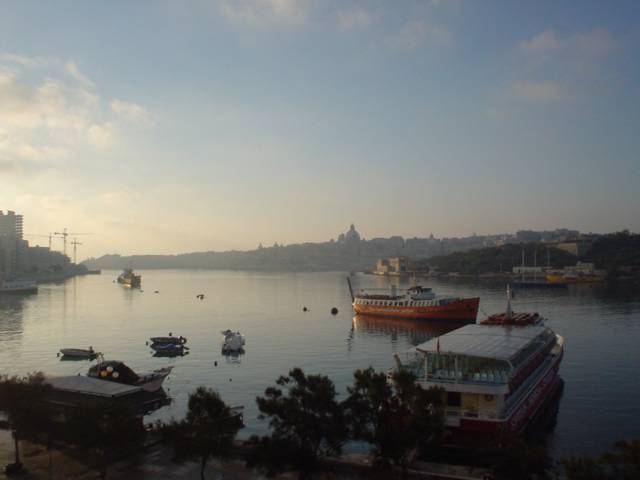
Sliema Strand (Malta)
Highlander


I just returned from the Island of Malta, check the view from my window ( I'll post more later), thanks to all those who emailed to ask about me, I appreciate it very much. Also I would like to tell you that I'm travelling tomorrow morning to the Libyan South ( desert country), I'm very excited about this trip... I have a satellite connection, but I don't think I want to blog from there. I wish to enjoy the peace and quiet...See you soon

Monday, August 30, 2004

Off to Malta !

Yes, yours truely is travelling again, just in case someone looks for me !
This is turning out to be a nice summer after all !

Thursday, August 26, 2004


Libyan Pop Idol
Highlander

Arab Pop Idol finale on 29th August
Ok now for some superfluous stuff. Superstar will come to an end next Sunday. The choice has narrowed between Amar from Palestine and Ayman from Libya. Both are excellent ! It's the first time I follow a star search programme but hey Ayman is an extremely talented singer in addition to being a student in his second year of dental medicine ... so I'll be rooting for him. He needs all the support we can muster. If anyone is reading this of whatever nationality please vote for him by calling 00239 4444484 or by internet (this is the form) you have to register by clicking the first time thingy in English , you will get a password sent to your email, then to vote you scroll down and choose the candidate ( see photos and description) , then you scroll down some more and type your email and the password sent to you in the boxes at the bottom then you click on the small orange icon near the 2 boxes .. sorry that the website is 99% Arabic , but hope my instruction were clear ! This programme has achieved what no one was able to do for a long time: uniting Arab countries for a cause ( 10 million viewers had tuned in for last Sunday's episode) - well art is a good cause I guess and we all need a hero so why not. Don't forget to vote !

One more thing, if you were wondering , voting from Libya by mobile or landline is not free ( don't listen to rumours), a whooping 0.75 LD is deducted from my cellphone credit everytime I vote and to vote from a landline it is 0.32 LD. so for ten votes it's 7.5 LD which is more than one employees salary per day.


Update 29/8/04

CONGRATULATIONS TO AYMAN FOR A WELL EARNED WIN!

Result of the Arab vote 54% out of 3 million and 200,000 people have voted for Ayman as the Arab pop Idol or Superstar for the year 2004! I'm really happy for him as he believed in his talent and ambition and persevered. I think it was an excellent result because we in Libya were only able to vote by cellphone since end of June 2004 while for the contestants of the other Arab countries voting was possible since February 2004. As for use of landlines it was only possible in the last 2 episodes unlike for the othere countries since February as well. Moreover, I expected Amar the Palestinian contestant to win because mobiles, phones and internet services was disrupted about 3 days before the finale in Libya and I could not use the voting services for mobile 8888 nor the landline 1414, nor the internet link for futuresuperstar, this goes to show that it was not the less than 5 million Libyans whereby only about 100,00 have cell phones , but the votes from the Arab world fans which secured his win. So much for the rumour about using the voting service for free ;)

Wednesday, August 25, 2004


Plan of Midhat Pasha souk in Damascus -Syria it's like a fantastic labyrinth there , that cannot be fully explored in one day.
Highlander

Door and handle of a Libyan house in the Old City. 29th May 2004. This is a test. Finally it's working after I fixed my PC.
Highlander

Monday, August 09, 2004

SYRIA PART IV


ALEPPO


Aleppo is one of the Great Middle Eastern cities, a city where one can still find the grandeur of Arabic life of a bygone era. Once the major commercial center of the Orient, it is still vibrant with traders coming from all over the world to buy, sell, barter and haggle in its traditional covered Souks, the newer shopping districts and center-city offices. There are no "tourist" shops in the Aleppo souks; these are still the center of everyday shopping for Aleppo and its suburbs where everything, from djellabas to gold, can be had for a price. Lofty vaulted roofs keep the souk cool in the summer heat, while the age-old ritual of Middle Eastern commerce takes place. Near the Khan al-Sabon is the gold souk, a place of tiny shops, brightly lit and shining with golden bangles, necklaces and earrings.


Settlements in the Aleppo area go back to the 8th millennium BC. The city's name Halab (an Aramaic word for milk) comes from the fable that Abraham is supposed to have milked his flocks on this site. Halab, was the name of the city when it became the capital of the Amorite Kingdom of Yamhad. This city/state was strong enough to control trade between the Eastern Mediterranean and Mesopotamia.

Hittites, Assyrians, Persians and Greeks dominated the city and, after the death of Alexander the Great, Aleppo (renamed Beroia) became an affluent center in the classic Greek style. It almost reached the prominence of Antioch under the Romans and retained its importance with but a few interruptions, until almost the end of the Ottoman Empire. It was considered the third most important city of the Empire, after Constantinople and Cairo, and was the seat of the Governor.

Liberated from Turkish rule in 1918, Aleppo lost its international commercial pre-eminence in 1939 when the French ceded Alexandretta (Aleppo’s historic seaport) to the Turkish Republic.


The Aleppo Citadel is an immense fortification in the very center of the Old City. A fortified site as far back as the first millennium BC, it became the palace of the Hamdanid and Ayyubid rulers. Rebuilt by the Mamelukes after it's destruction by the first Mongol invasion, it was again devastated by Tamerlane's hordes. Its imposing entrance was rebuilt in the 13th century after the first Mongol destruction and reinforced in the 16th century


My favourite is walking through the medieval parts in the old city which is still inhabited whereby I would almost hear the hooves of bygone horses and the conversation of the horsemen.


HAMA

Hama (Hamath), situated between Homs and Aleppo on the banks of the Orontes rive and almost hallways between Damascus and Aleppo by motorway. It is an important agricultural and industrial center. Except for Damascus, Hama is considered the most picturesque city in Syria because of its attractive gardens along the river banks.

The chief attractions of Hama are the great norias (water-wheels). Originating in Byzantine times, the oldest surviving wheels date from the 13th century. The norias, which all have given names, were used to raise water from the river into aqueducts. As this function is now carried out by electric pumps, the purpose of the wheels today is purely decorative and of historical interest.


SYRIA PART III : DAMASCUS

There are lots of places to visit in Syria, and I won’t go over them all and I have not been to all of them either. The sites that are a must in Damascus are Souq Hamidiye, the Citadel, Nur al-Din Hospital and Museum, Madrasat Zahiriye and Adiliye, the Tomb of Salah al-Din and the Omayyad Mosque which has an interesting feature to Christians namely the South-East minaret called Madhanat Issa, or the Tower of Jesus. According to Muslim tradition Jesus will descend to earth via this tower to fight the Antichrist before the Day of Judgment. Also the Azem Palace museum and Souq Assagha (the gold market). Do not miss a visit to the Hammam al-Malik al-Zaher (Turkish style steam room, massage room, and bath). Dating from the 11th or 12th century the baths have been completely restored and modernized.

Souk Midhat Pasha, is an important trading center situated inside the wall of old Damascus. No historian could trace its origins, which means it is very old. It extends along the western street between Bab al Jabiya and Souk al Bouzouriya paralleling Souk al Hamidiya in the west with many small bazaars branching from it on both sides. Each souk specializes in some items, fabrics, clothes, rugs, herbs, cleaning material, spices, perfumes, kitchen ware etc.. It was Hussein Nazem Pasha who covered the souk with a roof in 1911 with corrugated tin and iron boards to protect it from fire, you can still see the bullet and shell holes made by the French troops who shelled the Alhariqa area in 1925.


At the top of the Qassiun Mountain, towering over Damascus and the Rukn al Din area is the Shrine of the 40 Warriors built over a cave as old as humanity itself, called the Cave of Blood, with reference to it being the spot of the first crime: where Cain killed his brother Abel. Historians say that it also became the place of a temple which was transformed into a convent then to a mosque in 635 AC. It is not known exactly when the shrine was built in the cave but it was first mentioned by the historian Asaker ibn Dimasq in 1175 AC. Its most popular name is the 40 men, because of the bodies of the 40 holy warriors buried in the mosque. These 40 men are famous martyrs ( Shuhada’)who when they were buried legend has it that all raised their right legs out of the tomb in unison to show that the body of a martyr ( Shahid) never rots. My mother swears that when she visited the shrine as a child she actually saw the 40 legs and they looked full of life, and the smell coming out from the earth was beautiful centuries after these men had died. Nowadays you are not allowed to touch the bodies of these warriors and the legs have been covered not to be abused by crowds. So this place is important in 2 ways, Abel died there, and it is the last repose of some heroic men.

SYRIA PART II

Syria or Bilad Alsham as it is also called used to encompass Lebanon, Palestine, Jordan and some parts of Iraq, before being sliced into morsels by the colonialists. Syria can also boast being the cradle of civilization even before being a biblical land. Syria is also called Bilad Al’awliya or home of the Saints, because an incredible number of prophets and saints are buried there going back to Adam. To the eye of a Westerner, you may be a little bit disappointed at the greyish tinge of pollution and smoke covering Damascus’s buildings but to me it is all part of the package you cannot help but fall in love with the place. Meandering in the old city, the souks, the shopping areas, the residential areas, the food stalls or 5 star restaurants everything is a joy. The women are beautiful with a natural beauty, and the men are still chivalrous. I’m not painting an overly romantic picture of the place because I am aware that there is poverty, dirt and backwardness, I’ve seen that with my own eyes …but still I love it all and most of all the delicious food. The meat in Syria tastes differently than in Libya, because sheep and cattle graze organic pastures, unlike in Libya which has to rely on imported feedstock even for chicken. Only camel meat in Libya still tastes lovely because it is allowed to graze freely and fish taste wonderful and unadulterated still. The vegetables and fruits are a joy to the eye in the Syrian markets, especially for someone like me who comes from a parched country. Europeans are amazed at the diversity and choice of fruits and vegetables in the Syrian markets and stalls, and the prices are ridiculously low. Almost everyone can eat decently and healthily there. The Syrians love food and they share common dishes with Lebanon, Jordan, Palestine and Turkey. The people are extremely hospitable, though not overbearing or nosy about foreigners.

The Ugarit civilization in ancient Syria dates to the second millennium BC , it has been discovered in 1929, it is considered a part of the long Arab history, its rites are still being practiced in our modern society, and its language is relevant to our modern Arabic in terms of Alphabet, vocabulary, syntax etc..Many documents dating back to the 13th and 14th centuries BC have been discovered these include literary texts, epics, mythologies, religious rites, pedagogic principles, and laws, political, economic and agricultural texts. The people of Ugarit, our ancestors, were the first to have developed the language from mere shapes to a systematic alphabet, and into letters rather than syllables; thus changing the course of history. It is worth noting that with the discovery of Ugarit and its language, 8 other languages have been discovered in Ras Shamra. It is true that there have been other pioneer alphabets in the world but up to this day and as several undoubted studies confirm, Ugarit’s alphabet is the oldest and the most perfect alphabet discovered yet. Historical evidence proves that inhabitants of the Syrian coast carried this knowledge to Greece and from there to other places in the world. The Greek historian Herodot referred to this when he said that the ‘Phoenicians who came from Qadmous (in Syria) , brought the Greeks a lot of their cultural achievements ,writing is one of them’.